Why Your AI Pilot Worked and the Full Rollout Didn't
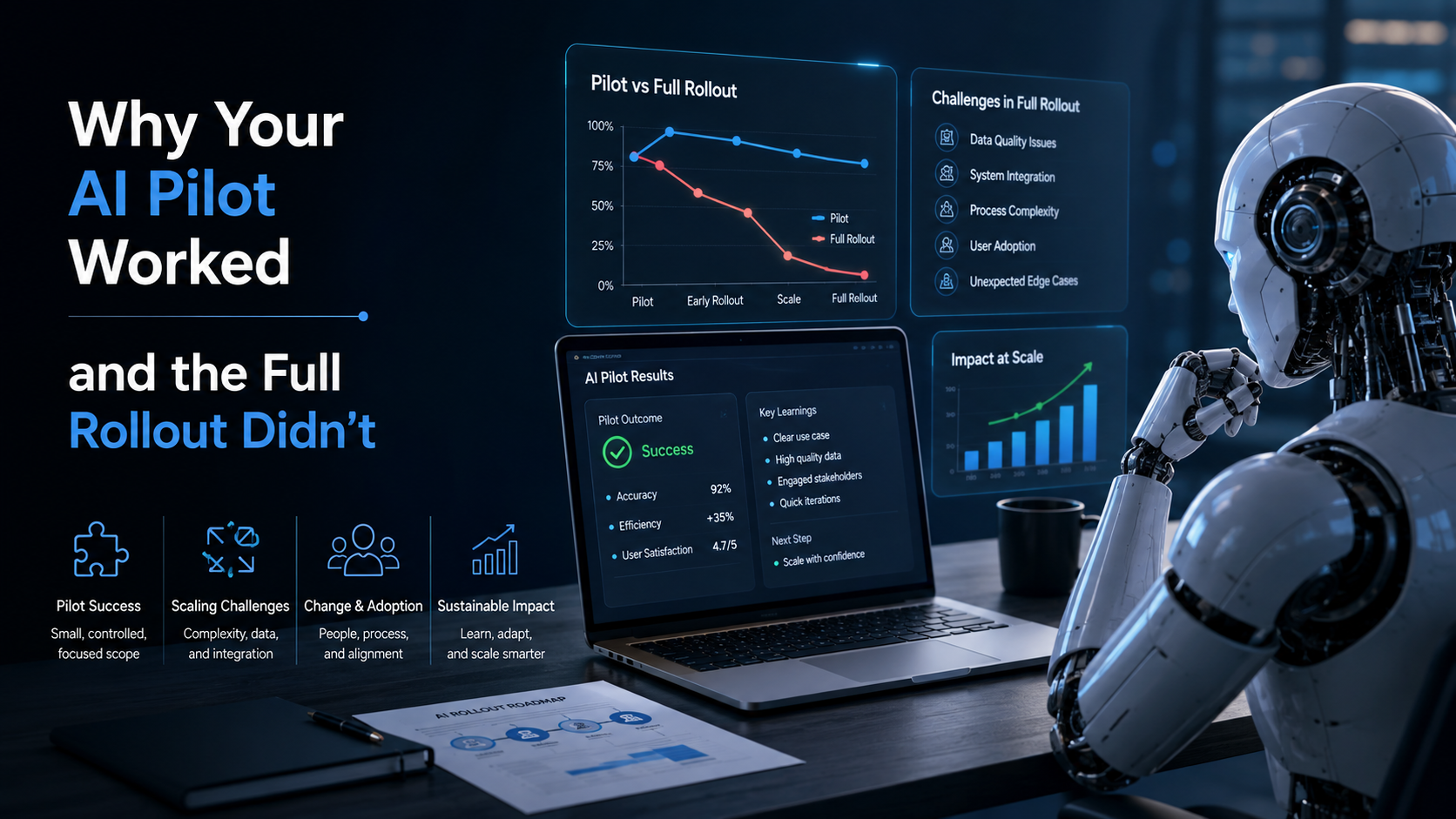
Where the gap between a successful pilot and a struggling rollout actually comes from
Introduction
A pilot proves an idea works under favorable conditions. A full rollout has to work under real ones — messier data, higher volume, more edge cases, and users who weren't hand-picked for the test. The gap between a successful pilot and a struggling rollout is one of the most common, and most avoidable, disappointments in business AI adoption.
Why Pilots Succeed More Easily Than They Should
Pilots are typically run with a curated dataset, a motivated group of early users, and a narrower scope than the eventual full deployment. None of this is dishonest — it's a reasonable way to test a concept quickly. The problem is treating pilot success as proof the same system will perform equally well once those favorable conditions disappear.
Where the Gap Actually Comes From
Real Data Is Messier Than Pilot Data
A pilot often runs on a clean, representative sample. Full rollout means the system encounters the actual range of your data — inconsistent formatting, incomplete records, the edge cases that didn't happen to show up in a smaller sample. An AI system tuned against clean pilot data can underperform noticeably once it meets the real thing.
Volume Changes Behavior, Not Just Load
Some issues only appear at scale — response latency under real concurrent usage, cost per interaction that looked reasonable at low volume and adds up differently at production scale, or accuracy that degrades slightly as the range of inputs widens. A pilot with a hundred interactions can look flawless while hiding a failure rate that becomes visible only at ten thousand.
Pilot Users Aren't Representative of Everyone
Early pilot participants are often more forgiving, more technically comfortable, or more invested in the system succeeding than the general user base will be. Full rollout means the system meets users who weren't selected for patience or enthusiasm, and their experience is a more honest test of whether the system actually works for everyone.
Integration Depth Was Often Simplified for the Pilot
A pilot frequently uses a simplified or partial integration to move quickly. Full rollout usually requires the AI to connect properly with production systems, live data, and existing workflows — a level of AI integration work that's easy to underestimate when the pilot skipped most of it.
Success Criteria Weren't Actually Defined the Same Way
A pilot deemed "successful" based on qualitative feedback or a small sample doesn't necessarily meet the harder, quantitative bar a full rollout needs to justify its cost and scope. Without consistent success metrics carried from pilot to rollout, the comparison itself becomes unreliable.
How to Design a Pilot That Actually Predicts Rollout Success
Test against a realistic, not curated, sample of your data. Include a meaningfully sized group of typical, not especially favorable, users. Build the pilot's integration close to what production will actually require, rather than a shortcut version. Define the same success metrics you'll use to evaluate the full rollout, before the pilot starts, not after.
What to Do When a Rollout Is Already Underperforming After a Strong Pilot
Go back to the specific gap — is it data quality, scale-related behavior, user representativeness, or integration depth — rather than assuming the whole system needs to be scrapped. Most rollout struggles trace to one or two of these specific gaps, not a fundamental flaw in the underlying approach, and identifying which one narrows the fix considerably.
Frequently Asked Questions
Why does an AI system that performed well in a pilot sometimes underperform at full rollout?
Pilots often run on cleaner data, smaller scale, more favorable users, and simplified integrations — full rollout exposes the system to conditions the pilot didn't test.
How can a pilot be designed to better predict rollout success?
Use a realistic, not curated, data sample, include typical users rather than especially favorable ones, build integration close to production requirements, and define success metrics upfront that match what the rollout will be measured against.
What's the first thing to check if a rollout is underperforming after a successful pilot?
Identify which specific gap applies — data quality, scale-related behavior, user representativeness, or integration depth — rather than assuming the whole approach failed.
Does a larger pilot always predict rollout success better?
Size helps, but representativeness matters more — a large pilot using the same curated data and favorable users has the same blind spots as a small one.
Ready to build something like this?
Let’s talk about what AI-accelerated, human-validated development can do for your business.
Start Your Project