What "Human in the Loop" Actually Means in Practice (Not Just as a Buzzword)
What "human in the loop" actually means, broken into specific, evaluable questions
Introduction
"Human in the loop" has become one of those phrases that gets attached to nearly any AI system as a kind of reassurance — a signal that a human is involved somewhere, so the system is safe. In practice, the phrase covers a wide range of very different implementations, some of which provide real oversight and some of which are barely more than a formality. Understanding what it actually means, concretely, matters more than the label itself.
Why the Vague Version of the Phrase Is a Problem
"There's a human in the loop" tells you almost nothing on its own. A human reviewing every single output before it's used is meaningfully different from a human who could theoretically review output but almost never actually does. Both technically satisfy the phrase. Only one of them provides real oversight.
The Specific Questions That Define What It Actually Means
At What Point Does the Human Get Involved?
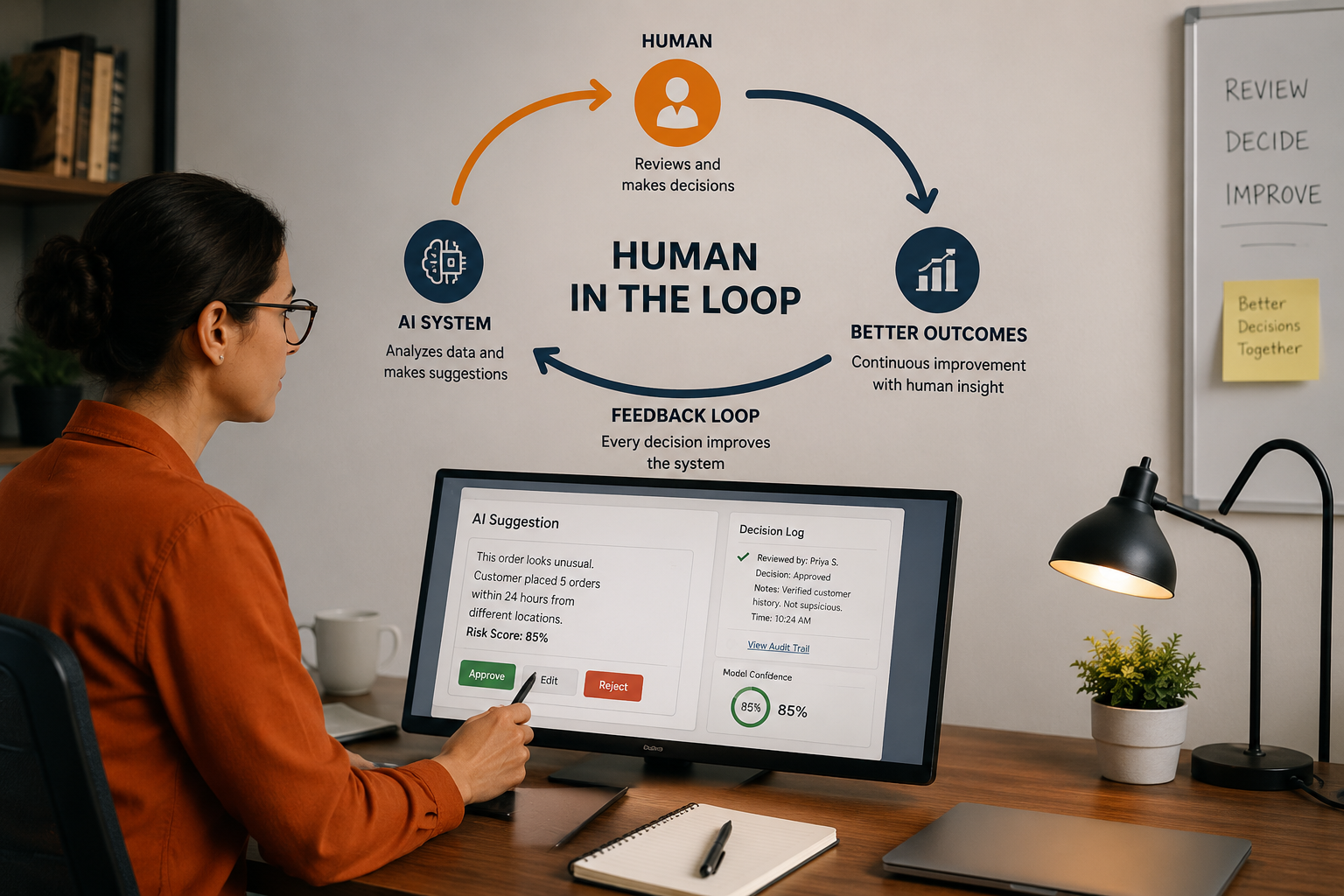
Review can happen before an action takes effect, immediately after, or only when something is flagged as unusual. Pre-action review provides the strongest safeguard but adds latency. Post-action review catches problems after they've already happened. Exception-only review is efficient but depends entirely on the system correctly identifying what counts as an exception.
What Percentage of Output Actually Gets Reviewed?
A human in the loop for 100% of decisions is a fundamentally different system than one where a human is nominally available but only reviews a small, spot-checked sample. Both can be described with the same phrase, but they provide very different levels of actual oversight.
Does the Human Have Enough Context to Meaningfully Evaluate the Output?
A reviewer glancing at an AI-generated output without the underlying context to judge whether it's actually correct isn't providing real oversight, even if they're technically in the approval chain. Meaningful review requires the reviewer to have what they need to catch an error, not just the opportunity to.
What Happens When the Human Disagrees or Rejects the Output?
A defined path for correction — sending it back for revision, escalating, stopping the process entirely — determines whether human involvement actually changes outcomes, or whether disagreement just gets logged without affecting what happens next.
Is the Human Reviewing Individual Decisions or Just Monitoring Aggregate Performance?
Reviewing dashboards and metrics after the fact is a legitimate form of oversight for some use cases, but it's a different kind of "human in the loop" than reviewing individual, consequential decisions before they take effect. Conflating the two overstates the safeguard in place.
Where Strong Human-in-the-Loop Design Actually Matters Most
The categories worth the strongest human oversight are the same ones worth caution in AI development generally — actions with real financial, legal, or customer-relationship consequences, and situations where the AI system's confidence is genuinely uncertain. Lower-stakes, high-volume decisions can reasonably use lighter-touch oversight, like aggregate monitoring, without meaningfully increasing risk.
How to Evaluate a Vendor's Claim of Human Oversight
Ask the specific questions above directly: when does review happen, what percentage of output is actually reviewed, does the reviewer have adequate context, and what happens when they disagree. A vendor who can answer these concretely has likely built real oversight into the system. A vague answer, or one that reduces to "a human could look at it if needed," is worth treating with real skepticism.
Why This Matters for Trust in AI Automation More Broadly
"Human in the loop" as a phrase has become a way to signal caution without necessarily practicing it. Businesses evaluating AI systems — their own or a vendor's — get a much clearer picture of actual risk by asking what the phrase specifically means in that implementation, rather than accepting it as reassurance on its own.
Frequently Asked Questions
Does "human in the loop" always mean the same thing?
No. It can mean anything from 100% pre-action review to a human who could theoretically check output but rarely does — the phrase alone doesn't specify which.
What makes human review actually meaningful rather than just a formality?
The reviewer needs enough context to genuinely evaluate the output, and there needs to be a defined path for what happens when they disagree or reject it.
Is monitoring aggregate performance the same as human-in-the-loop review?
It's a legitimate but different form of oversight than reviewing individual decisions before they take effect — conflating the two overstates the actual safeguard in place.
What should I ask a vendor who claims their AI system has human oversight?
Ask when review happens, what percentage of output is actually reviewed, whether the reviewer has adequate context, and what happens when they disagree with the output.
Ready to build something like this?
Let’s talk about what AI-accelerated, human-validated development can do for your business.
Start Your Project