The Dependency Update We Almost Skipped (and What It Would Have Cost Us)
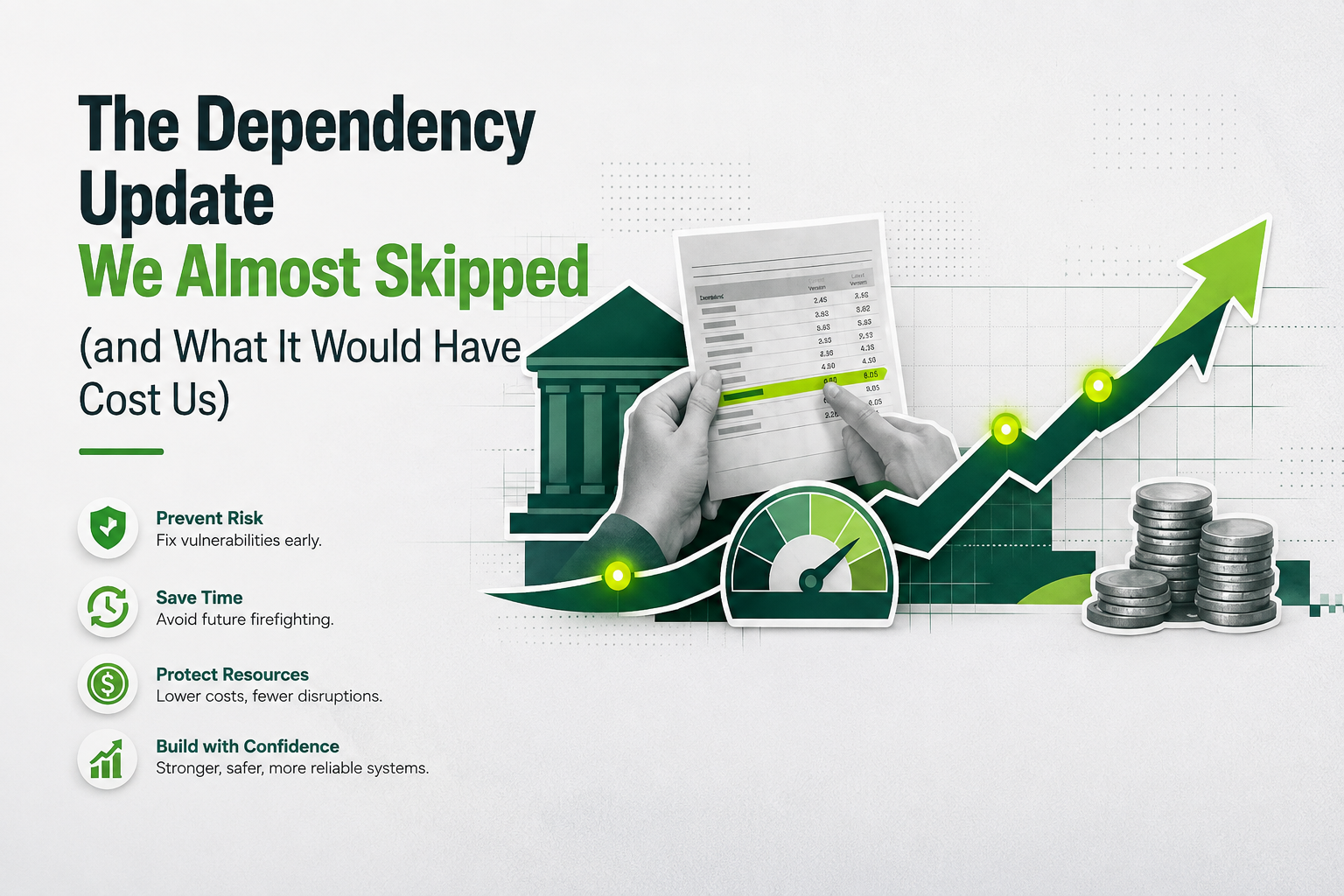
A routine update deprioritized for weeks, until a security advisory changed the calculation
Dependency updates have a reputation for being the least urgent item in any backlog. Nothing's broken, the current version works, and there's always something that feels more pressing. That reputation is exactly what let this specific update sit deprioritized for weeks longer than it should have.
What the Update Actually Was
A minor version bump to a widely-used library in one of our client projects, flagged by our automated dependency scanning as available but not urgent - no known vulnerability at the time it first appeared, just a routine update. It stayed in the backlog behind feature work for several sprints, which is the normal, usually harmless fate of most minor version bumps.
What Changed the Calculation
A security advisory was published for the older version we were still running -after we'd already deprioritized the update, not before. The vulnerability wasn't catastrophic, but it was real, and it existed specifically in the version we hadn't yet moved off of. We had, in effect, been carrying a known risk for weeks without knowing it, simply because "not urgent yet" had quietly become "indefinitely postponed."
What It Would Have Cost Us to Stay Deprioritized
Had we not caught the advisory when we did, the realistic cost wasn't hypothetical - it was an emergency patch cycle instead of a routine one: rushed testing, an off-schedule deployment, and the kind of reactive scramble that a routine update, done on a normal timeline, would have avoided entirely. The actual code change required was small. The cost we avoided was almost entirely about timing, not complexity.
Why "No Known Vulnerability Yet" Isn't the Same as "No Risk"
The core mistake wasn't ignoring a known problem - there wasn't one when we first deprioritized it. The mistake was treating "no known issue currently" as a permanent state rather than a snapshot that could change at any time without warning. A dependency with no advisory today can have one tomorrow, and a project that's several versions behind by the time that happens has a harder, riskier update to make than one that stays current incrementally.
What We Changed Afterward
We stopped treating dependency updates as a single backlog category prioritized purely by urgency-at-time-of-review. Now, routine dependency updates get a maximum staleness window - regardless of whether anything currently flags them as risky -after which they get scheduled regardless of what else is competing for sprint time. This converts "keep dependencies current" from a standing intention that's easy to deprioritize indefinitely into a concrete, enforced cadence.
We also changed how we monitor for new advisories on dependencies already in use, not just at the point of initially adding them - since the entire incident happened because a dependency that was fine when added became risky later, silently, without anyone re-checking.
The Broader Point
This wasn't a story about a dramatic breach - nothing was actually exploited. It's a story about how "low priority" maintenance work quietly accumulates real risk precisely because nothing forces a re-evaluation of that priority over time. The fix wasn't more urgency in the moment. It was a process that doesn't require anyone to notice the urgency has changed before acting on it.
Frequently Asked Questions
Was the dependency actually exploited before it got updated?
No. A security advisory was published for the version still in use, but the update was applied before any actual exploitation occurred.
Why did a routine update get deprioritized in the first place?
It had no known vulnerability when it was first flagged, so it was reasonably treated as low-urgency maintenance and repeatedly pushed behind feature work.
What specifically changed in the process afterward?
Routine dependency updates now have a maximum staleness window enforced regardless of perceived urgency, and dependencies already in use are actively monitored for new advisories, not just checked when first added.
What was the real cost this incident avoided?
An emergency patch cycle with rushed testing and an off-schedule deployment, instead of the same small code change handled on a normal, planned timeline.
Ready to build something like this?
Let’s talk about what AI-accelerated, human-validated development can do for your business.
Start Your Project