RAG vs Fine-Tuning: Which Approach Fits Your Business Data?
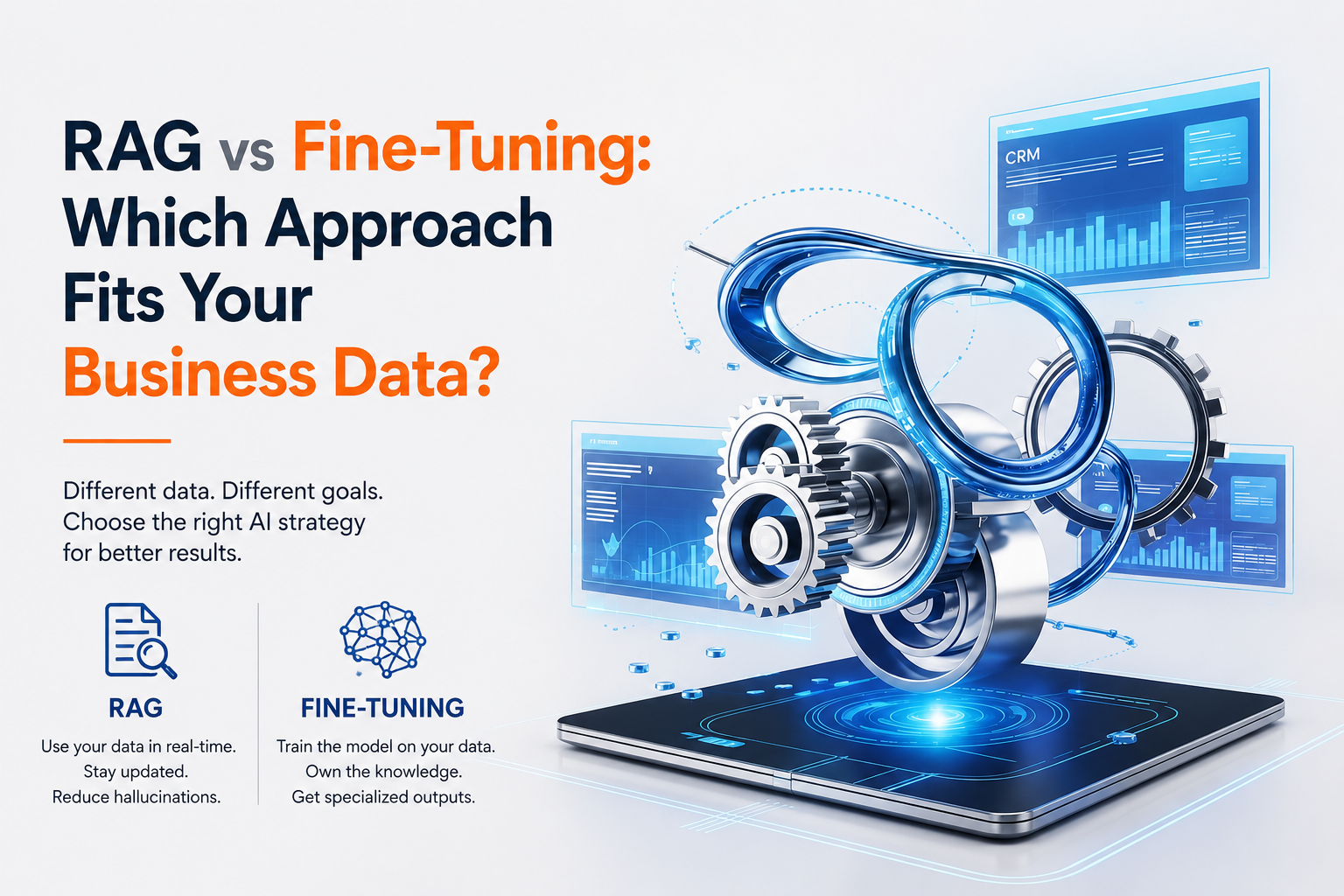
RAG retrieves relevant data at query time; fine-tuning changes the model itself
Once a business decides to build an AI system around its own data, the next question is almost always the same: fine-tune a model, or build a retrieval-augmented generation (RAG) system? Getting this wrong means paying for infrastructure that doesn't fit how your data actually changes.
What RAG Actually Does
RAG keeps your data in its original, searchable form and retrieves the most relevant pieces at the moment a question is asked, feeding that context to the AI model to generate an answer. The model itself isn't changed.
What Fine-Tuning Actually Does
Fine-tuning takes an existing model and further trains it on your specific data, so the model's own behavior shifts to reflect that data directly.
Why This Distinction Matters for Your Business
How Often Your Data Changes
If your data updates frequently, RAG is almost always the better fit - updating means updating documents, not retraining a model.
How Much Data You Actually Have
RAG can work effectively with a smaller, less rigidly formatted dataset than fine-tuning typically requires.
Whether You Need Traceable Answers
RAG systems can show which source document an answer came from -important for legal, financial, or healthcare-adjacent use cases.
Budget and Ongoing Maintenance
RAG typically has lower ongoing cost for businesses with regularly changing data.
Where Fine-Tuning Is Actually the Better Choice
Fine-tuning fits well when the goal is changing how a model behaves -tone, format, domain-specific reasoning - and the underlying knowledge is genuinely stable.
Can You Use Both?
Yes - a fine-tuned model for domain-specific reasoning combined with a RAG layer for up-to-date, traceable factual grounding is a strong approach for many enterprise implementations.
How to Decide for Your Business
Start with your data's update frequency and your need for source traceability. An AI consulting conversation early on is the cheapest point to get this decision right.
Frequently Asked Questions
Is RAG cheaper than fine-tuning?
Generally yes, for businesses with regularly updating data, since RAG avoids retraining a model every time information changes.
Do I need a large dataset for RAG to work well?
No. RAG works with your existing documents as-is, without the large structured dataset fine-tuning typically requires.
Can RAG show where an answer came from?
Yes, RAG systems can reference the specific source document, which fine-tuned models generally cannot do as clearly.
Should every business use RAG instead of fine-tuning?
No. Businesses with stable domain knowledge and a need to shift how a model communicates may be better served by fine-tuning, or a combination of both.
Ready to build something like this?
Let’s talk about what AI-accelerated, human-validated development can do for your business.
Start Your Project