Prompt Engineering vs Custom AI Development: When a Better Prompt Isn't Enough
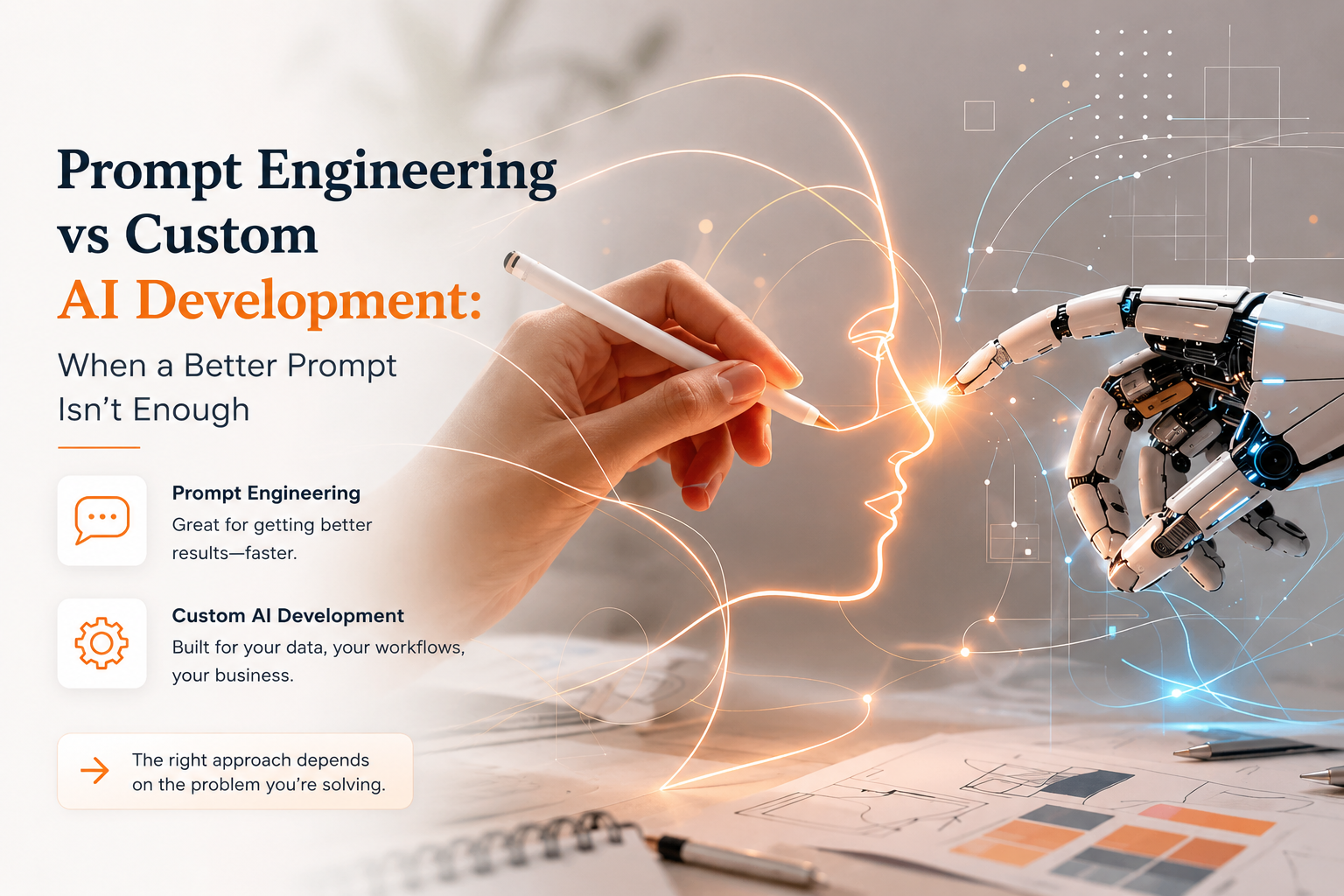
The point where prompt refinement stops solving the problem and custom development starts
Introduction
Prompt engineering has genuinely closed the gap between "we have an idea for using AI" and "we have something working" for a large number of business use cases. It's also created a common misconception: that any AI problem can eventually be solved with a good enough prompt. Some can. Many can't, and knowing the difference before investing more time refining a prompt that was never going to get there is worth understanding clearly.
What Prompt Engineering Actually Solves Well
For tasks involving a single model interaction — drafting content, summarizing a document, classifying a piece of text, answering a well-scoped question — a carefully constructed prompt can produce genuinely reliable, high-quality results without any custom development at all. This is a real, cost-effective solution for a meaningful share of business use cases, and it shouldn't be dismissed in favor of unnecessary custom builds.
Where Prompt Engineering Starts to Hit a Ceiling
The Task Requires Persistent Memory or State
If a use case needs to remember information across multiple interactions, track a process over time, or maintain context beyond a single exchange, a prompt alone can't do that — this requires actual application logic to store and retrieve state, which is custom development, not prompt refinement.
The Task Requires Connecting to Live Business Data
A prompt can't query your database, check current inventory, or pull a customer's account status in real time. Any use case that depends on live, structured data from your systems needs integration work — connecting the AI to actual data sources — which is a different problem than wording a prompt more precisely.
The Task Requires Multiple Coordinated Steps
Complex workflows — gathering information, making a decision, taking an action, verifying the result — usually need orchestration logic to coordinate those steps reliably, which is the domain of AI agent development rather than a single prompt, however well constructed.
Reliability Requirements Are High and Non-Negotiable
Prompts alone don't have built-in error handling, retry logic, or validation of output before it's used downstream. For use cases where a wrong or malformed output has real consequences, custom development adds the structural safeguards a raw prompt-and-response interaction doesn't include on its own.
The Same Prompt Needs to Perform Consistently Across Very Different Inputs
A prompt tuned carefully for a narrow set of example inputs can behave unpredictably on inputs it wasn't tuned against. If your real-world data is highly varied, this is often a sign the underlying system needs more structure — validation, fallback logic, structured data handling — than prompt wording alone can provide.
The Practical Signal Worth Watching For
If you find yourself repeatedly patching a prompt to handle a new edge case, and the list of edge cases keeps growing rather than converging, that's usually the clearest sign you've moved past what prompt engineering can reliably solve. Each additional patch is diminishing return on a problem that custom development would solve more directly.
Why This Distinction Matters for Budget and Timeline
Prompt engineering is fast and inexpensive relative to custom development, which is exactly why it's worth trying first for straightforward use cases. But continuing to invest time refining a prompt for a problem that structurally needs custom development — memory, live data, orchestration, reliability guarantees — costs more in the long run than recognizing the ceiling early and scoping the right solution.
How to Decide Which Category Your Use Case Falls Into
Ask whether the task is a single, well-scoped interaction with static context, or whether it involves memory, live data, multiple steps, or high-stakes reliability requirements. The first fits prompt engineering well. The second usually needs some combination of AI integration, AI agent development, or custom AI development — and getting an outside opinion before over-investing in prompt refinement alone can save real time.
Frequently Asked Questions
Can prompt engineering solve most AI use cases on its own?
For single, well-scoped interactions like drafting, summarizing, or classification, often yes. It hits a ceiling with tasks needing memory, live data, multiple coordinated steps, or high reliability guarantees.
What's a clear sign a use case needs custom development instead of a better prompt?
Repeatedly patching a prompt to handle new edge cases, where the list of exceptions keeps growing rather than converging, usually signals the underlying problem needs custom development.
Why can't a prompt access live business data?
A prompt alone has no connection to your systems. Pulling real-time data like inventory or account status requires integration work connecting the AI to those data sources.
Is prompt engineering a waste of time if custom development might eventually be needed?
No. It's often worth trying first for straightforward cases since it's fast and inexpensive - the key is recognizing early when a use case structurally needs more than a prompt can provide.
Ready to build something like this?
Let’s talk about what AI-accelerated, human-validated development can do for your business.
Start Your Project