How Much Should an AI Chatbot Actually Cost? A Realistic Pricing Breakdown
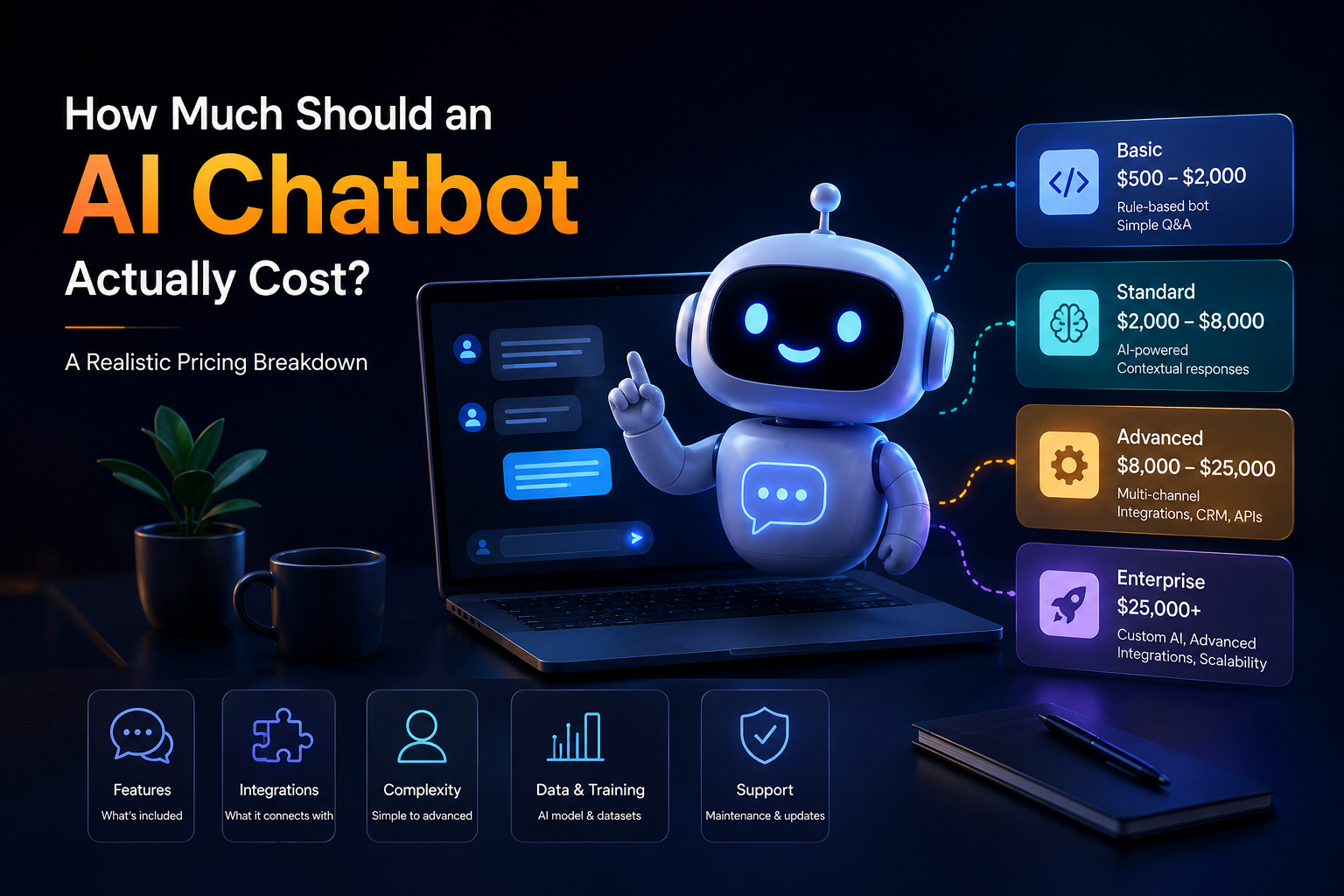
What actually drives AI chatbot cost, factor by factor
Introduction
Ask three different vendors for an AI chatbot quote and you'll often get three very different numbers, with little explanation of why. This isn't necessarily a sign someone's overcharging or underdelivering — chatbot cost depends heavily on scope, and scope varies enormously behind the single word "chatbot." Understanding what actually drives the cost makes it possible to evaluate a quote honestly, rather than comparing numbers without context.
Why "Chatbot" Isn't a Single Price Point
A chatbot that answers a fixed set of FAQs from a static document is a fundamentally different build than one that accesses live account data, handles multi-step conversations, and escalates intelligently to a human. Both get called "a chatbot." Their costs shouldn't be compared as if they're the same product.
The Factors That Actually Drive Cost
Scope of What the Chatbot Needs to Do
FAQ-style answering is the least expensive category. Adding account-specific queries, transactional capability, or multi-step reasoning increases cost proportionally to the complexity of what's being automated.
Data Sources It Needs to Draw From
A chatbot pulling from a single static knowledge base costs less than one requiring RAG development across multiple, evolving data sources, or one needing real-time integration with live business systems.
Level of Integration With Existing Systems
Connecting a chatbot to your CRM, order system, or internal databases through proper AI integration adds real engineering work beyond the conversational AI component itself, and is often the single largest cost driver in enterprise chatbot projects.
Escalation and Human Handoff Requirements
Building a reliable, context-preserving handoff to a human — rather than a dead-end "contact support" message — adds meaningful development work, particularly for chatbots handling higher-stakes conversations.
Accuracy and Reliability Requirements
A chatbot for casual, low-stakes inquiries has different testing and reliability requirements than one used in regulated industries or for anything financially or legally consequential. Higher reliability requirements mean more testing, validation, and error-handling work.
Ongoing Maintenance and Monitoring
Initial build cost is only part of the picture. Ongoing costs include keeping the underlying knowledge base current, monitoring performance, and refining the system based on real usage — costs that continue well past launch and should be factored into any realistic budget comparison.
A Rough Sense of Where Costs Typically Land
A simple, FAQ-style chatbot with a static knowledge base sits at the lower end of the cost range. A chatbot with moderate integration — pulling some live data, handling a defined set of transactional tasks — sits meaningfully higher. A fully custom, deeply integrated enterprise chatbot with multi-system access, sophisticated escalation logic, and high reliability requirements sits at the top of the range, and reasonably so, given the scope involved.
How to Evaluate a Quote You've Received
Ask specifically what's included in the number — which of the cost drivers above are covered, and which would be additional. A quote that doesn't clearly map to scope is harder to evaluate fairly, regardless of whether the number itself seems high or low. The goal isn't finding the cheapest quote — it's understanding what you're actually being quoted for.
Why the Cheapest Option Isn't Always the Better Deal
A significantly cheaper quote for what sounds like the same scope often means a narrower actual scope, less integration depth, or less investment in reliability and testing — differences that tend to surface after launch, in exactly the areas we've written about being easy to underestimate in chatbot implementations. Comparing quotes on scope, not just price, is what actually determines value.
Frequently Asked Questions
Why do AI chatbot quotes vary so much between vendors?
"Chatbot" covers a wide range of scope, from simple FAQ answering to deeply integrated, transactional systems — quotes vary because the underlying scope varies, not necessarily because of overcharging or underdelivering.
What's usually the biggest cost driver in an enterprise chatbot project?
Integration with existing systems — connecting the chatbot to a CRM, order system, or internal databases — is often the largest single cost factor beyond the conversational AI itself.
Does chatbot cost end at launch?
No. Ongoing maintenance, knowledge base updates, and performance monitoring continue after launch and should be factored into a realistic budget.
Is a cheaper chatbot quote always a worse deal?
Not necessarily, but a significantly cheaper quote for seemingly the same scope often reflects a narrower actual scope or less investment in integration and reliability — worth clarifying before comparing purely on price.
Ready to build something like this?
Let’s talk about what AI-accelerated, human-validated development can do for your business.
Start Your Project