How AI Agents Handle Errors and Edge Cases (and Why That Matters More Than Speed)
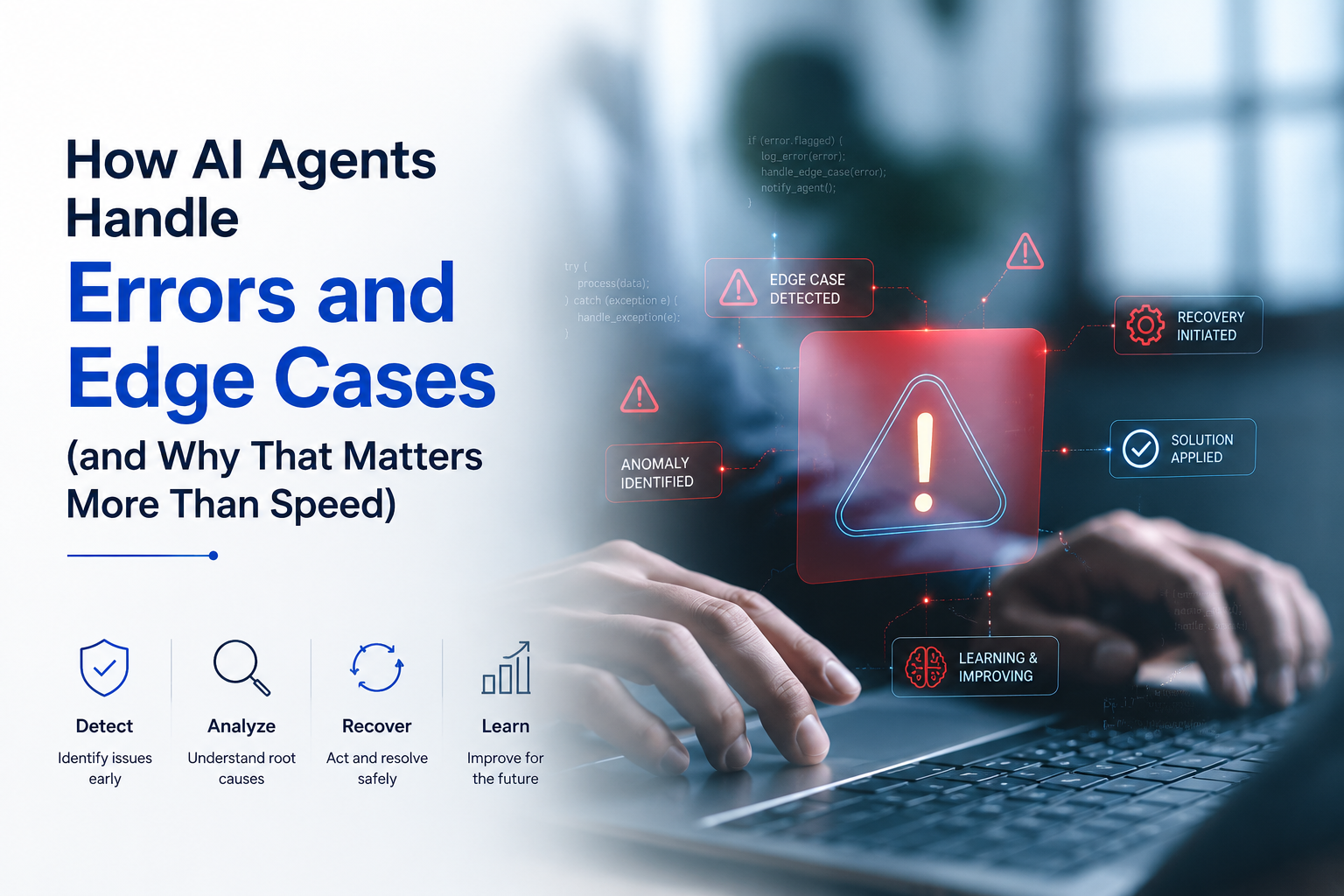
An AI agent flagging uncertainty rather than pushing through with a confidently wrong answer
Introduction
When evaluating AI agent solutions, speed tends to dominate the conversation — how fast it completes a task, how quickly it responds. Speed matters, but it's not the metric that determines whether an AI agent is actually trustworthy in a real business environment. Error handling is.
Why Error Handling Matters More Than Raw Speed
A fast AI agent that handles an unexpected input by producing a confidently wrong result is worse than a slower one that recognizes it's uncertain and flags the situation for review. The cost of a fast, wrong action — especially one that isn't caught immediately — is almost always higher than the cost of a short delay.
What Good Error Handling in an AI Agent Actually Looks Like
Recognizing When It's Operating Outside Its Reliable Range
A well-built AI agent has some awareness of its own confidence level and is designed to flag situations where the input doesn't clearly match anything it can handle reliably, rather than proceeding as if it does. This is a deliberate design choice, not a natural byproduct of the underlying AI model.
Failing Visibly, Not Silently
The most dangerous failure mode isn't an agent that stops and reports a problem — it's one that continues operating and produces a subtly incorrect result nobody notices until later. Good agent design treats a visible failure as a much better outcome than an invisible one, even though a visible failure looks worse in the moment.
Having a Defined Escalation Path
When an AI agent encounters something outside its scope, what happens next matters as much as recognizing the problem. A defined path — flagging for human review, routing to a fallback process, pausing rather than guessing — determines whether an edge case becomes a minor, contained issue or a real one.
Logging Enough Detail to Actually Diagnose What Went Wrong
An agent that fails without leaving enough information behind to understand why makes every failure a fresh investigation. Agents built with production reliability in mind log the context around a failure specifically so patterns can be identified and addressed, not just individually patched each time.
How to Evaluate This When Assessing an AI Agent Solution
Ask directly what happens when the agent encounters an input it wasn't designed to handle. A vague or evasive answer to this question is a more meaningful red flag than a slower response time in a demo. Ask for a specific example of a real edge-case failure and how it was handled — a vendor who can answer this concretely has likely built the reliability structure that matters; one who can't may not have thought through this seriously yet.
Why This Connects Directly to Trust in Automation
Businesses that hesitate to expand AI automation into higher-stakes processes usually aren't hesitant because the AI is too slow — they're hesitant because they don't trust how it behaves when something goes wrong. Solid error handling is what actually builds the confidence needed to expand an AI agent's role over time, more than incremental speed improvements ever will.
The Trade-off Worth Accepting
A more cautious agent, one that occasionally pauses to flag uncertainty rather than pushing through every input at maximum speed, is usually the better long-term choice for business-critical processes. The perceived cost — a slightly slower average completion time — is small compared to the cost of an unflagged, confidently wrong action reaching a real customer or business decision.
Frequently Asked Questions
Why is error handling more important than speed in an AI agent
A fast agent that fails silently on an edge case produces a confidently wrong result that may go unnoticed, which is more costly than a slightly slower agent that flags uncertainty visibly.
What does good error handling look like in an AI agent?
Recognizing when it's operating outside its reliable range, failing visibly rather than silently, having a defined escalation path, and logging enough detail to diagnose what went wrong.
What question should I ask when evaluating an AI agent vendor?
Ask directly what happens when the agent encounters an input it wasn't designed for, and request a specific real example — vague answers here are a meaningful red flag.
Does better error handling slow down an AI agent?
It can add a small amount of latency in edge cases, but this trade-off is worth accepting for business-critical processes where a wrong, unflagged action carries real cost.
Ready to build something like this?
Let’s talk about what AI-accelerated, human-validated development can do for your business.
Start Your Project