AI Chatbots vs Live Chat Support: When You Still Need a Human on Standby
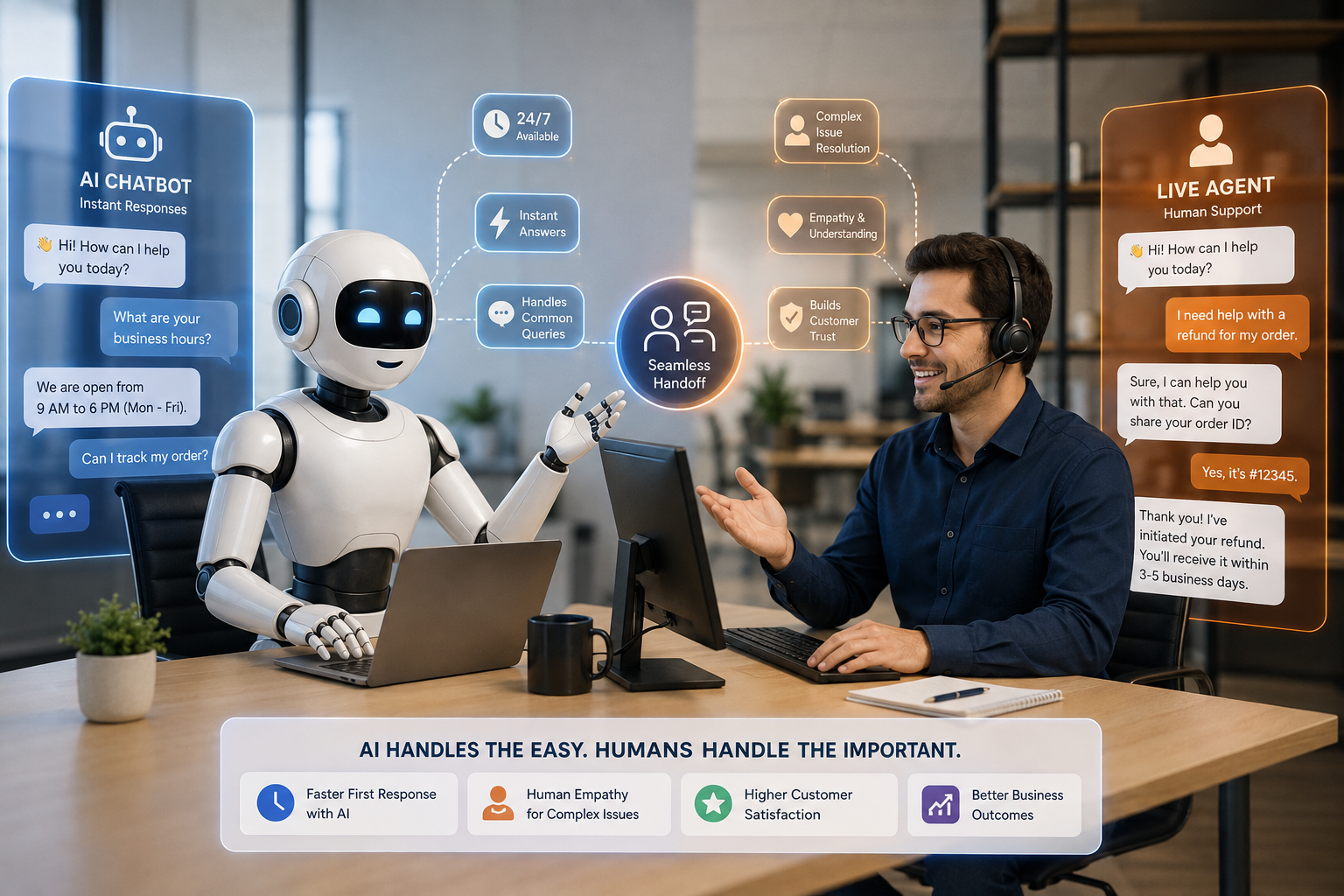
Deciding which support categories genuinely benefit from automation, and which still need a human
Introduction
The pitch for AI chatbots often implies a straightforward trajectory: automate more, staff less, save money. For some support operations, that trajectory is right. For others, removing humans from the loop entirely creates a worse customer experience than a well-designed hybrid approach would. The right answer depends on what your support actually needs to handle, not a general assumption that more automation is always better.
Where AI Chatbots Genuinely Outperform Live Chat
For high-volume, repetitive inquiries — order status, basic account questions, common troubleshooting steps — an AI chatbot responds instantly, at any hour, without the queue times that live chat inevitably introduces during peak periods. This isn't a compromise version of support; for these categories, it's often a better customer experience than waiting for a human.
Where a Human on Standby Still Matters
Emotionally Charged or High-Stakes Situations
A customer dealing with a billing dispute, a service failure, or a situation involving real frustration generally responds better to a human who can express genuine empathy and exercise judgment than to an AI system, however well-designed, handling the same conversation.
Genuinely Novel or Ambiguous Problems
Issues that don't fit a recognizable pattern — the kind of situation an AI chatbot wasn't specifically trained to handle — need a human who can reason through something unfamiliar, rather than a system attempting to force-fit an unusual problem into a familiar response.
High-Value or High-Risk Customer Relationships
For enterprise accounts, high-value transactions, or situations where getting the interaction wrong risks losing an important relationship, the cost of a human handling it directly is usually justified by what's at stake.
Situations Requiring Real Discretion or Judgment Calls
Some support interactions require weighing context and making a judgment call that isn't reducible to a policy an AI system can apply consistently. These need a human empowered to make that call.
The Real Question: Where's the Line, Not Whether There Is One
The useful design question isn't "AI or human" — it's identifying which categories of inquiry genuinely benefit from automation and which specifically need human handling, then building a system where escalation between the two is smooth rather than a dead end. A chatbot that recognizes it's out of its depth and hands off cleanly, with context preserved, delivers a genuinely better experience than either pure automation or an all-human team.
Why the Handoff Matters as Much as the Split Itself
A poorly designed handoff — where a customer has to repeat everything they already told the chatbot once a human picks up — undermines the value of automation even when the underlying split between AI and human handling was reasonable. Building a handoff that preserves conversation context is as important as deciding what gets automated in the first place.
How to Decide the Right Split for Your Business
Look at your actual support volume by category: what percentage is routine and repetitive versus complex or emotionally significant. High-volume, routine categories are strong automation candidates. Low-volume, high-stakes categories usually aren't, regardless of how sophisticated the underlying AI chatbot development is. Most support operations land somewhere in between, with a defined mix rather than an all-or-nothing answer.
Ready to build something like this?
Let’s talk about what AI-accelerated, human-validated development can do for your business.
Start Your Project